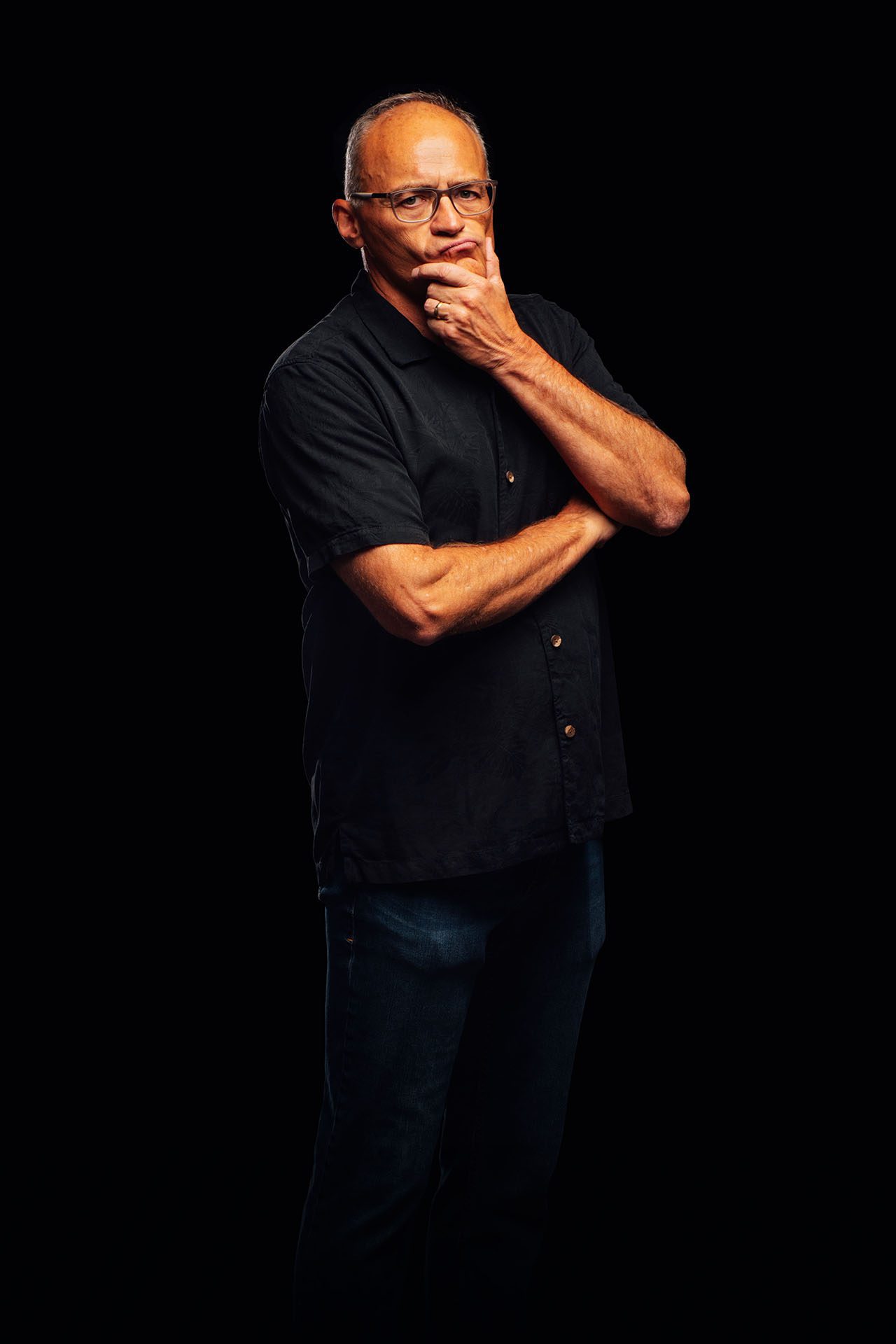
For more than four decades, comedian Brad Upton has made a career out of finding humor in everyday life. From the frustrations of marriage and parenting to the undeniable realities of getting older, Upton has mastered the art of transforming life’s most relatable moments into unforgettable laughter. But behind the sharp observations, impeccable timing, and seemingly effortless punchlines is a man whose journey has been filled with unexpected triumphs, heartbreaking losses, and a renewed appreciation for the gift of making people smile.
Long before becoming an internet sensation, Upton was a schoolteacher and track coach who discovered that commanding a classroom and entertaining a comedy club required surprisingly similar skills. After spending decades perfecting his craft, his career experienced an extraordinary resurgence in its 34th year, introducing his comedy to millions of new fans and proving that sometimes the biggest opportunities arrive when you least expect them.
Now, with his latest stand-up special, CODE BLUE, Upton is delivering some of the most personal and meaningful material of his career. What might sound like a medical emergency becomes an unforgettable comedic examination of aging, relationships, health scares, and the unpredictable journey of life itself.
However, beneath the laughter lies a powerful story of resilience. Following a frightening heart attack in 2022, Upton spent three years finding the courage to transform that experience into material for the stage. Combined with the emotional weight of losing several beloved family members, CODE BLUE reveals a side of the veteran entertainer that audiences rarely get to see: the vulnerable human being behind the microphone.
In an entertainment industry often obsessed with overnight success and viral fame, Upton’s story serves as a reminder that longevity, authenticity, and perseverance can be just as powerful as the perfect punchline.
In this exclusive conversation with We Own The Laughs’ Tyson Paul, Brad Upton opens up about his remarkable career resurgence, the emotional journey behind CODE BLUE, unforgettable lessons from working alongside legendary entertainer Johnny Mathis, and the challenges of finding humor during life’s darkest moments. He also reflects on marriage, generational differences, the evolution of stand-up comedy, and why the person making an audience laugh might be fighting battles nobody knows about.
For Brad Upton, comedy has always been about making people laugh. But after more than 40 years onstage, he’s discovering that sometimes the most meaningful laughter comes from having the courage to tell the truth.
CODE BLUE sounds like a medical emergency, but in your hands, it’s a comedy special. At what point did you realize that getting older wasn’t just becoming a personal inconvenience, but potentially some of the funniest material of your career?
Well….I didn’t have a choice. As much as I was in denial, I got older. You write what you know. Thirty-five years ago, I used to tell a story about tearing my hamstring while sprinting. Thirty-five years later, I have jokes about my total knee replacement.
You’ve spent more than four decades making people laugh, but CODE BLUE comes from a particularly personal chapter of your life. How did your experience with a serious health scare change not only the way you approach comedy, but also the way you appreciate life when you’re not onstage?
It’s never lost on me how lucky I am to do what I do for a living. There is always a moment in my show somewhere where I have a voice in my head that says, ‘You get to do this. This was your dream.’
There’s an old saying that wisdom comes with age, but your comedy suggests that age also comes with questionable drivers, pill organizers, and body parts that stop cooperating. What’s the biggest lie younger Brad Upton believed about getting older?
This is an excellent question. I truly believed I’d live to 100, never get unhealthy, and be one of those amazing 100-year-olds you see running in track meets. Turns out that wasn’t accurate.
Your comedy has always found humor in the differences between generations. If you could put a 25-year-old Brad Upton and today’s Brad Upton in the same room, what would they argue about first, and which version would have the better punchlines?
Older Brad would have told younger Brad to start taking care of himself right now. Younger Brad would have laughed at him. Older Brad definitely has better punchlines.
CODE BLUE finds comedy in marriage, parenting, and the little frustrations that come with sharing your life with someone. After years of turning family experiences into material, does your wife recognize when she’s living through a future joke, and has she ever told you a story was absolutely off-limits?
Yes, and she’s a saint. She knows it pays the bills, and I’m usually exaggerating. I dropped a joke in the special that she asked me not to do. Haha. Want to hear it? Of course you do. I tell the audience (truthfully) that for the last six years of my wife’s career, before she retired, she worked for the Gates Foundation in Seattle. Remember four or five years ago there were rumors that Bill Gates was having an affair? I said to my wife: Please tell me it’s you. You and Billy. Come on, I want a private jet. You and Billy. Yes! Is it not you? You let me down, honey.
You spent years working as a teacher and track coach before becoming widely recognized for stand-up. What did those experiences teach you about understanding people, handling pressure, and commanding a room that younger comedians might never learn at an open mic?
I tell people this for a laugh sometimes, but it’s absolutely true: teaching 10-year-olds and entertaining a roomful of drunks is the same skill set. There’s really no difference. Being in front of a classroom, commanding attention, keeping everyone focused…those are very valuable skills in standup.
Some comedians become famous overnight, while others spend decades building an audience before the internet discovers them. You’ve experienced a remarkable career resurgence. Was there ever a moment when you thought your biggest opportunities were behind you, only for life to surprise you with an entirely new chapter?
Absolutely! I blew up in year 34 of my career, right when I was starting to realize no break was ever coming. I had made peace with that. I had a very successful career before I got ‘discovered’. I always felt that if you did great work every night, in and out, year after year, someone would notice. That’s not always the case. I’d made peace with it, and then I blew up on the internet.
Your comedy connects with people who remember rotary phones and people who have never lived without smartphones. What’s the secret to making different generations laugh at the same joke, even when they’re laughing for completely different reasons?
That’s a good question. Luck? I am absolutely humbled when I have people in their 20’s and 30s buy tickets to my show. It means the world to me that younger people like me. I think the youngsters see me as a funny, cranky old uncle.
With CODE BLUE, you’re finding humor in subjects that can be genuinely frightening, including health, mortality, and the unpredictability of life. How do you know when a painful personal experience is ready to become a joke, and has there ever been a story you wanted to tell but weren’t emotionally ready to share?
I had my heart attack in May of 2022. People wrote to me, and I knew they were trying to be encouraging, that they were looking forward to my heart attack material. I told them there was going to be no material about my heart attack. It wasn’t a “quirky” experience. It was frightening. It was humbling. It took me three years to talk about it onstage, and if you’ve seen the special, you can see it’s still very difficult to be that vulnerable onstage. As far as a story I still haven’t told? Thirty-two years ago, the day after our perfect, first-born child was born, my wife was diagnosed with kidney cancer and given a 50% chance to live. I thought I was going to lose my wife and be a single dad with an infant. My comedy career would have been over. I can’t talk about nearly losing my wife. Thirty-two years later, it’s still raw.

You’ve shared stages and entertainment experiences with legendary performers throughout your career. What’s one unforgettable backstage conversation or unexpected piece of advice that completely changed the way you thought about success in show business?
I opened for Johnny Mathis for 18 years. If it was a two-show weekend, it was usually on a Thursday/Saturday or Friday/Sunday. Always a day off in between. The shows were always geographically booked so we could drive between them on the off day. I volunteered to drive Johnny. That didn’t last long because he wanted me to drive SLOW. I just couldn’t. I lost the driving job after about three attempts. But on one of those trips, it was just Johnny Mathis and me all alone in the car, talking about performing for nearly 3 hours. Maybe the greatest singer of all time, talking about stage presence, management, performance, etc. Also, watching Johnny always being absolutely gracious to his fans was inspiring. I knew he was exhausted. He just wanted to get to the hotel and go to sleep, but he was always a saint to his fans.
Comedy has changed dramatically since you first picked up a microphone in the 1980s. If you were starting your career today, with social media, viral clips, podcasts, and the pressure to constantly create content, do you think you’d thrive in today’s comedy industry, or would you tell everyone to put their phones down and actually enjoy the show?
Another good question. If I were starting now and in my 20s, I’d probably be all in, tuned into social media and how it works, so I’m guessing I would have been on board and figured it out. For an old guy, I think I do okay with social media. It’s a giant pain in the ass, but it’s now part of the business. When I started, cellphones didn’t exist; the audience could only watch the performance. Then phones came along. At first we had to learn how to deal with the ringers going off, but within a couple of years people learned how to mute them. For a while, you’d try to call out an audience member if you saw them looking at their phone. Now it’s pointless. You can absolutely be destroying a room, and 10% of the people will be staring at their phones.
You’ve spent a lifetime teaching audiences how to laugh at the things they can’t control. When people finish watching CODE BLUE, beyond the jokes and hilarious observations, what do you hope they understand about growing older, appreciating the people they love, and making the most of whatever time life gives them?
I’d like people to recognize that we comedians are sometimes going through things in our personal lives that they’ll never understand. The show must go on. Our job is to walk onstage and make people laugh. In 1998, my sister called me while I was performing in Las Vegas to tell me that my dad had been found dead in his bed that morning. I did two shows that night. The year and a half before I shot the special, I lost both my siblings to cancer and my mom to dementia. That person onstage that’s trying to make you laugh and bring you joy might be hurting on the inside.
After more than four decades in comedy, Brad Upton continues to prove that laughter can be found even in life’s most difficult moments. Through CODE BLUE, he shares a powerful reminder that aging brings more than challenges—it brings wisdom, perspective, and stories worth telling.
We Own The Laughs sincerely thanks Brad Upton for sharing his humor, honesty, and remarkable journey with us. His story reminds us that behind every great comedian is a human being navigating life’s highs and lows, one punchline at a time.
Because sometimes, the best medicine isn’t found in a hospital—it’s delivered through a microphone and a little laughter.


